Aquila Health Partners
  • Home
  • HOME
  • Meet the Team
  • Trainings
    • EMERGING WORKFORCE
    • ESTABLISHED PROFESSIONALS
    • PUBLIC / COMMUNITY
    • POLICY & DECISION MAKERS
  • Services
  • Contact
  • More
    • Home
    • HOME
    • Meet the Team
    • Trainings
      • EMERGING WORKFORCE
      • ESTABLISHED PROFESSIONALS
      • PUBLIC / COMMUNITY
      • POLICY & DECISION MAKERS
    • Services
    • Contact
  • Sign In
  • Create Account

  • Bookings
  • My Account
  • Signed in as:

  • filler@godaddy.com


  • Bookings
  • My Account
  • Sign out

Signed in as:

filler@godaddy.com
  • Home
  • HOME
  • Meet the Team
  • Trainings
    • EMERGING WORKFORCE
    • ESTABLISHED PROFESSIONALS
    • PUBLIC / COMMUNITY
    • POLICY & DECISION MAKERS
  • Services
  • Contact

Account

  • Bookings
  • My Account
  • Sign out

  • Sign In
  • Bookings
  • My Account

How Learning Happens: From Motivation to Impact

Advancing Maternal Cardiovascular Health Through Workforce Development and Systems Change

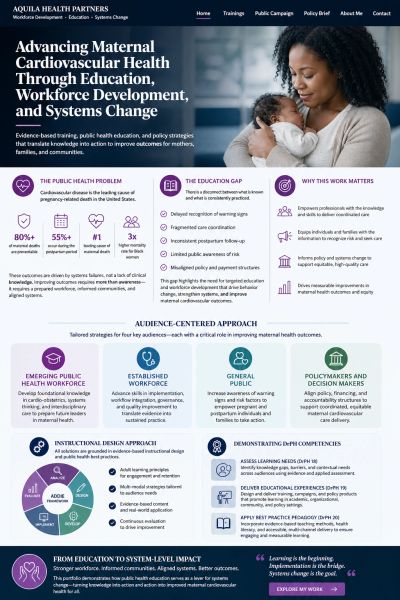
 Cardiovascular disease is the leading cause of pregnancy-related death in the United States, with the majority of these deaths considered preventable. Despite growing clinical knowledge, maternal mortality continues to be driven by delayed recognition of warning signs, fragmented care coordination, and inconsistent postpartum follow-up.  

Risk does not end at delivery. The postpartum period remains a critical and often under-addressed window where individuals experience ongoing cardiovascular vulnerability and reduced engagement with care systems. 

These patterns reveal that maternal mortality is not solely a clinical failure. It is the result of breakdowns across systems, workforce preparedness, and public awareness.

The Education and Workforce Gap

 A central challenge in maternal health is the disconnect between what is known and what is consistently practiced. Evidence demonstrates that preventable maternal deaths are frequently linked to failures in communication, escalation, and coordination rather than lack of clinical knowledge alone. 

This gap highlights the need for structured public health education and workforce development that:

  • Prepares professionals to apply evidence in complex systems 
  • Equips communities with knowledge to recognize and act on risk 
  • Aligns stakeholders around coordinated, interdisciplinary care 

Addressing maternal cardiovascular outcomes requires moving beyond awareness toward applied learning, behavior change, and system integration. We offer a variety of fitness programs that are tailored to your needs. From one-on-one personal training to group fitness classes, we have everything you need to get in shape and stay healthy.

Cardio-obstetrics: A Niche in Women’s Cardiovascular Health

 Cardio-obstetrics is an emerging clinical field focused on managing cardiovascular risk before, during, and after pregnancy. This video provides a clinical overview of how interdisciplinary care teams identify and manage risk to improve maternal outcomes, reinforcing the importance of early recognition and coordinated care. 

Audience-Centered Approach

Improving maternal health outcomes requires targeted strategies for distinct stakeholder groups, eac

Emerging Public Health Workforce

Future professionals must develop foundational knowledge of cardio-obstetrics, systems thinking, and interdisciplinary care models to effectively address maternal cardiovascular risk.

Established Workforce

Current practitioners require advanced training in implementation, workflow integration, governance structures, and quality improvement to translate evidence into sustained practice.

General Public

Pregnant and postpartum individuals need accessible, actionable education to recognize warning signs, understand risk, and seek timely care.

Policymakers and Decision Makers

System-level change depends on aligning policy, financing, and accountability structures to support coordinated, equitable maternal care delivery.


Instructional Design and Workforce Development Approach

All training, education, and communication strategies within this portfolio are grounded in evidence

 This includes:

  • Application of the ADDIE framework to guide systematic design, implementation, and evaluation 
  • Integration of adult learning principles to ensure relevance, engagement, and retention 
  • Use of multi-modal educational strategies tailored to audience context and learning needs 
  • Alignment of learning objectives, content, and evaluation to support measurable outcomes 

Educational approaches are intentionally designed to move beyond knowledge acquisition toward skill development, behavior change, and real-world application.

Explore the Training Portfolio

 View evidence-based training programs designed to strengthen workforce capability, improve implementation, and support better maternal health outcomes across multiple audiences. 

View Trainings

Copyright © 2026 Aquila Health Partners - All Rights Reserved.

Powered by

  • Services

This website uses cookies.

We use cookies to analyze website traffic and optimize your website experience. By accepting our use of cookies, your data will be aggregated with all other user data.

Accept